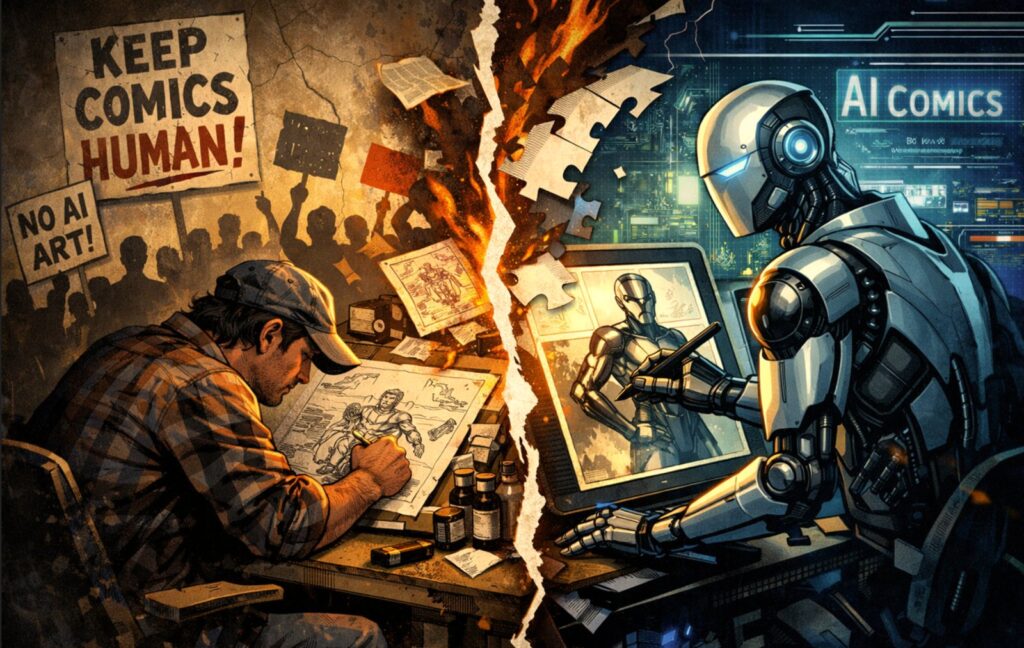
In 2025, mentioning AI in comics felt like lighting a match in a dry forest.
The resistance cut across generations. Younger creators feared being dismissed as illegitimate. Older artists worried that decades of hard-earned craft were being reduced to disposable prompts. In both cases, the use of AI in comics was treated as taboo, an act seen as stripping the medium of its authenticity.
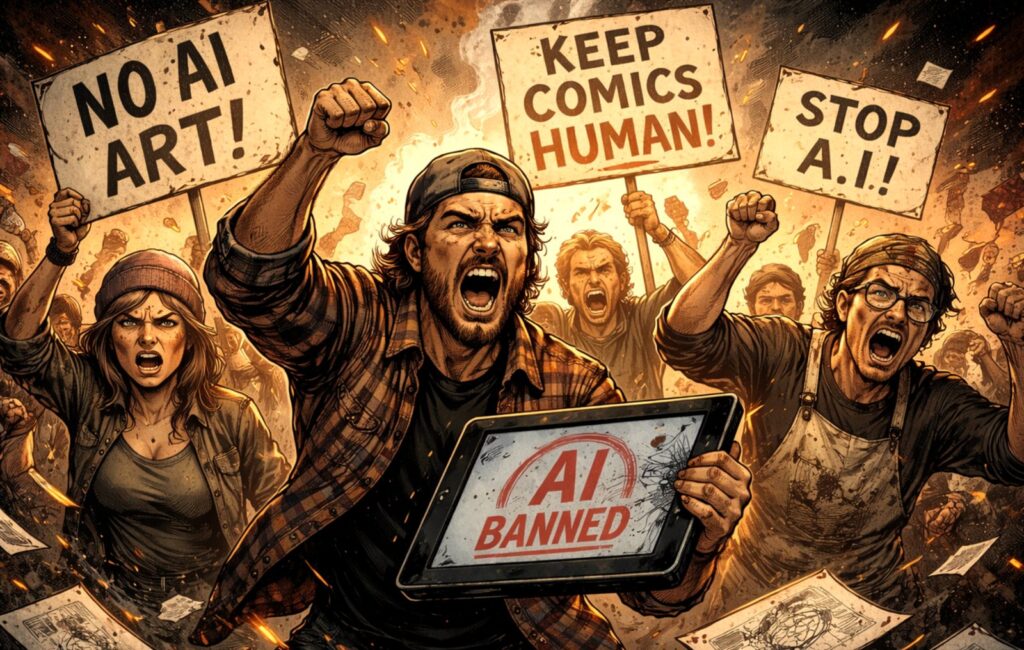
Creators who admitted to using AI, even when it was limited to assisting parts of their workflow, were mocked publicly. Some were ostracized from professional circles. Others were cancelled outright. This condemnation often came from surprising places: from audiences who routinely consumed pirated comics while condemning AI as unethical, and from peers who used digital shortcuts daily but drew an arbitrary line at machine assistance.
The backlash extended beyond comics. In animation and video games, creators were stripped of awards after it was revealed that AI had been involved in their production process, even when the final work was largely human-made. The message was clear: the presence of AI, regardless of scale or intent, invalidated the result.
This raises an uncomfortable but necessary question.
Is AI truly that destructive to creative authenticity?
Or is it simply a tool, poorly understood, emotionally charged, and unfairly scapegoated?
As the industry enters 2026, the conversation around comics, comics in AI, and webcomics and AI is evolving. What was once outrage is becoming strategy. What was once taboo is becoming infrastructure.
Why the Reaction in 2025 Was So Extreme
The hostility toward AI in comics did not emerge from nowhere. Comics have always been an intensely personal medium. Line work, pacing, and panel composition are not merely technical choices; they are signatures. For many creators, the process itself is inseparable from the identity of the artist.
AI disrupted that relationship.
Unlike previous tools, AI appeared to intrude into areas traditionally associated with creative judgment. Early AI systems were opaque, trained on vast datasets without clear consent mechanisms. This fueled fears of plagiarism, exploitation, and creative erasure. For an industry already struggling with low pay, piracy, and burnout, AI felt like an existential threat rather than a neutral innovation.
But much of the anger was misdirected.
The real issue was not AI itself, but how quickly it arrived without a shared ethical framework.
AI Is Not the Work. It Is the Workflow
A critical distinction was lost in much of the 2025 discourse: AI is not the product. It is part of the pipeline.
In comics, AI has been used primarily to:
– Generate rough layouts and perspective guides
– Assist with background elements in non-story-critical panels
– Test lighting and color palettes
– Support lettering, cleanup, and localization
– Speed up iteration during pre-production
These functions do not replace authorship, storytelling, or artistic intent. They replace repetition.
This is not unprecedented. The industry has undergone similar transitions before: digital inking replacing traditional tools, Photoshop replacing physical color separation, and 3D models supporting complex environments. Each shift was initially resisted, then normalized.
AI differs mainly in perception, not function.
The Piracy Contradiction
One of the most revealing aspects of the AI backlash was who participated in it. Many vocal critics of AI were also regular consumers of pirated content. This contradiction exposed a deeper truth: the outrage was less about ethics and more about cultural anxiety.
AI became a symbol of loss, loss of control, loss of identity, loss of relevance. It was easier to condemn the tool than to confront the structural issues that have long plagued the comics industry, from weak monetization to global piracy.
What 2026 Actually Looks Like for AI in Comics
By 2026, AI will no longer be a headline issue. Its use will be normalized, standardized, and largely invisible.
Publishers are already integrating AI quietly into pre-production. Webcomics platforms are using it to accelerate localization and maintain consistent release schedules. Independent creators are adopting it to reduce burnout without sacrificing quality.
The market is shifting from moral posturing to practical outcomes. Readers are less concerned with how a comic was made than with whether it is compelling, consistent, and worth paying for.
In short, AI will not replace creators.
Creators who understand AI will replace those who refuse to adapt.
How Creators Should Approach AI
The path forward is not uncritical adoption, nor outright rejection. It is intentional use.
Creators who thrive in 2026 will:
– Maintain full creative control over narrative and final visuals
– Use AI for speed and support, not originality
– Be transparent about their process
– Preserve a recognizable personal style
– Treat AI as an assistant, not a substitute
Authenticity is not determined by tools. It is determined by decision-making.
Why AI Is Economically Necessary for Publishers
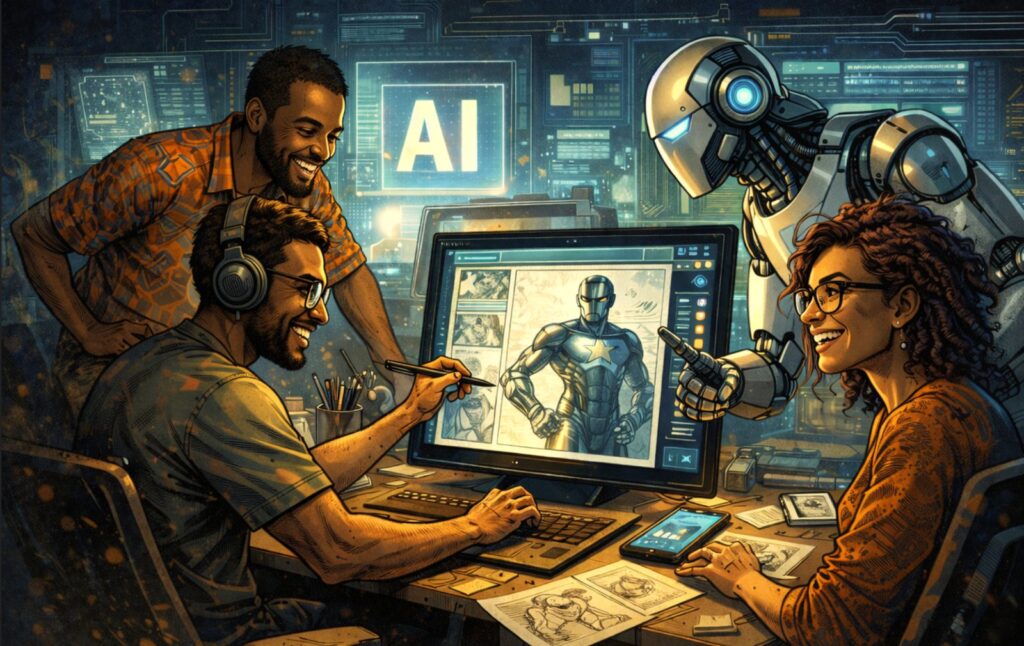
For publishers and organizations, AI is not about replacing artists. It is about sustainability.
AI enables faster production cycles, broader global reach, better content testing, and more efficient use of resources. In an industry where margins are thin and competition for attention is fierce, these efficiencies are not luxuries, they are survival mechanisms.
Platforms exploring webcomics and AI are already seeing higher retention driven by consistency and volume, not diminished quality.
The Real Question the Industry Must Answer
The debate around AI in comics has never truly been about technology. It has been about control, trust, and fear of change.
AI does not determine the soul of a comic. Humans do.
As 2026 unfolds, the creators and publishers who understand this distinction will move forward quietly, producing more work, reaching wider audiences, and building sustainable careers.
The rest will continue arguing about a future that has already arrived.
FAQ: AI and Comics
Is AI replacing comic artists?
No. AI automates tasks, not creative judgment.
Are AI-assisted comics authentic?
Yes. Authenticity comes from authorship and intent, not tools.
Will publishers require AI use?
Some will encourage it for efficiency, but human creators remain central.
Is AI ethical in webcomics?
It is ethical when used transparently and without misrepresentation.
Should new creators learn AI tools?
Yes, alongside storytelling, anatomy, and composition.